· 4 min read
Is today a good day to visit a museum?

There are some questions you just can’t shake off. For me, it’s this one: Is today a good day to visit a museum?
It doesn’t come from a leadership course, but from a novel. And, of all places, that’s where a mentee sent me; thank you very much Waltraud Hermann (external link, opens in a new tab). After one of our conversations, she said: “I think the book *The Big Five for Life* would suit you.” She was right – more so than she realised at the time.
Three terms that go hand in hand
John Strelecky (external link, opens in a new tab) tells the story of Joe, a disillusioned employee, and Thomas Derale, an entrepreneur whom he describes as the world’s greatest leader. What a claim. And what a bold assertion.
Derale runs his businesses in accordance with two guiding principles:
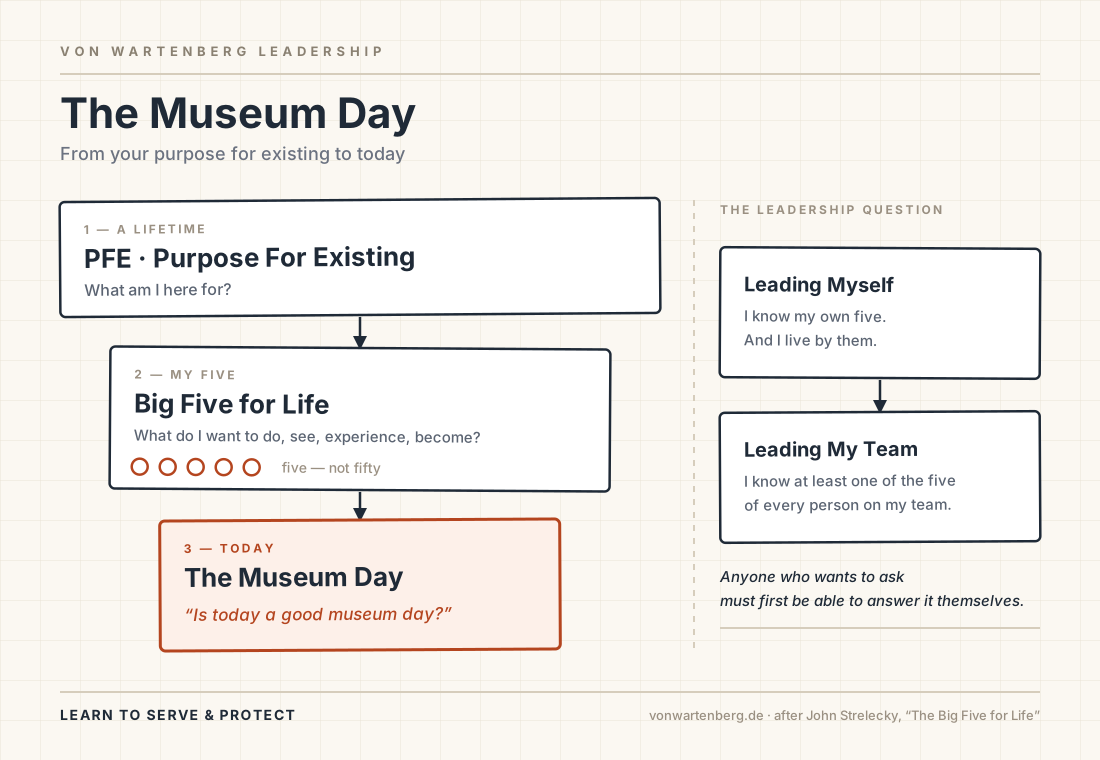
The POE – the purpose of existence. What am I here for? And: what is this company here for? Not as a marketing slogan, but as the answer you need first thing in the morning.
The Big Five for Life. Not a bucket list with 200 items, but five things I want to do, see, experience or become in my life. The number is the real trick: five forces you to make a decision.
Museum Day. Imagine that, at the end of your life, you are being shown round a museum. On display is your life – every day, every hour. Not the life you had planned, but the one you actually lived. How many rooms would you like to skip?
This turns into a daily check that takes less than two seconds: Is today a good day to visit the museum?
Why this is a leadership issue
The most remarkable thing about Derale is not that he knows his own ‘Big Five’. It is that he knows his staff’s. He asks about them during the interview. He only hires someone if he sees a genuine connection between that person’s purpose and the company’s purpose.
This is fiction, and I do not wish to present it as a management lesson. The novel does not provide a study, but rather a picture. Yet this picture captures something that is well supported by empirical evidence: people achieve exceptional results when they experience their work as self-determined, effective and meaningful. Meaning is not a ‘soft’ factor. It is the very condition under which sustained performance can arise in the first place.
And it’s an uncomfortable question – for us managers, first and foremost. Because if you want to ask your staff about their Big Five traits, you need to know your own. ‘Leading Myself’ comes before ‘Leading My Team’. Not in terms of hierarchy within the organisational chart, but in terms of credibility.
What mentoring has to do with this
I have been a mentor for many years. And in these conversations, I regularly find myself in the role of the mentee – this is no accident, but rather the real value of the process. In confidential conversations, you quickly get to the questions that have no place in day-to-day business. The book recommendation above (and see below) is the best example: the impetus came from the mentee to the mentor.
Anyone who treats mentoring as a one-way street is throwing away half the benefit.
My own standards
I have set myself the goal of becoming the best leader in the world. That sounds presumptuous, and I know I’ll never quite get there. That’s exactly why it works: as a direction, not as a title. For me, that means Learn to Serve and Protect – to serve and protect, getting a little better every day.
Three questions to take away
- 1What are your five – and when was the last time you wrote them down?
- 2How many people in your team do you know at least one of their Big Five traits for?
- 3And the shortest of them all: Is today a good day to visit a museum?
Dr. Peter v. Wartenberg (12.21)
Book recommendation: John Strelecky, The Big Five for Life – What really matters in life (external link, opens in a new tab). I highly recommend the audiobook. If you’d like to read on: Shaping your life with the Big Five for Life (external link, opens in a new tab) – this is where fiction meets a real company that has been run according to similar principles for decades.
Here’s a song that really moved me:
Clicking “Load video” establishes a connection to YouTube (in privacy-friendly mode). Data may be transmitted to the provider - see our privacy policy.