· 7 min read
Who am I without a title? Your greatest transformation is yet to come!
Why leaving your career isn’t a question of pensions, but a question of identity, and why you should tackle it now.
“Peter, do you actually realise that your greatest transformation is still ahead of you?”
That’s more or less what Andreas, a good friend and former colleague, told me shortly after he himself had retired. At first, I laughed. I’ve been through, managed and taken responsibility for quite a few transformations in my life: locations, countries, organisations, restructurings. What could possibly be bigger than that?
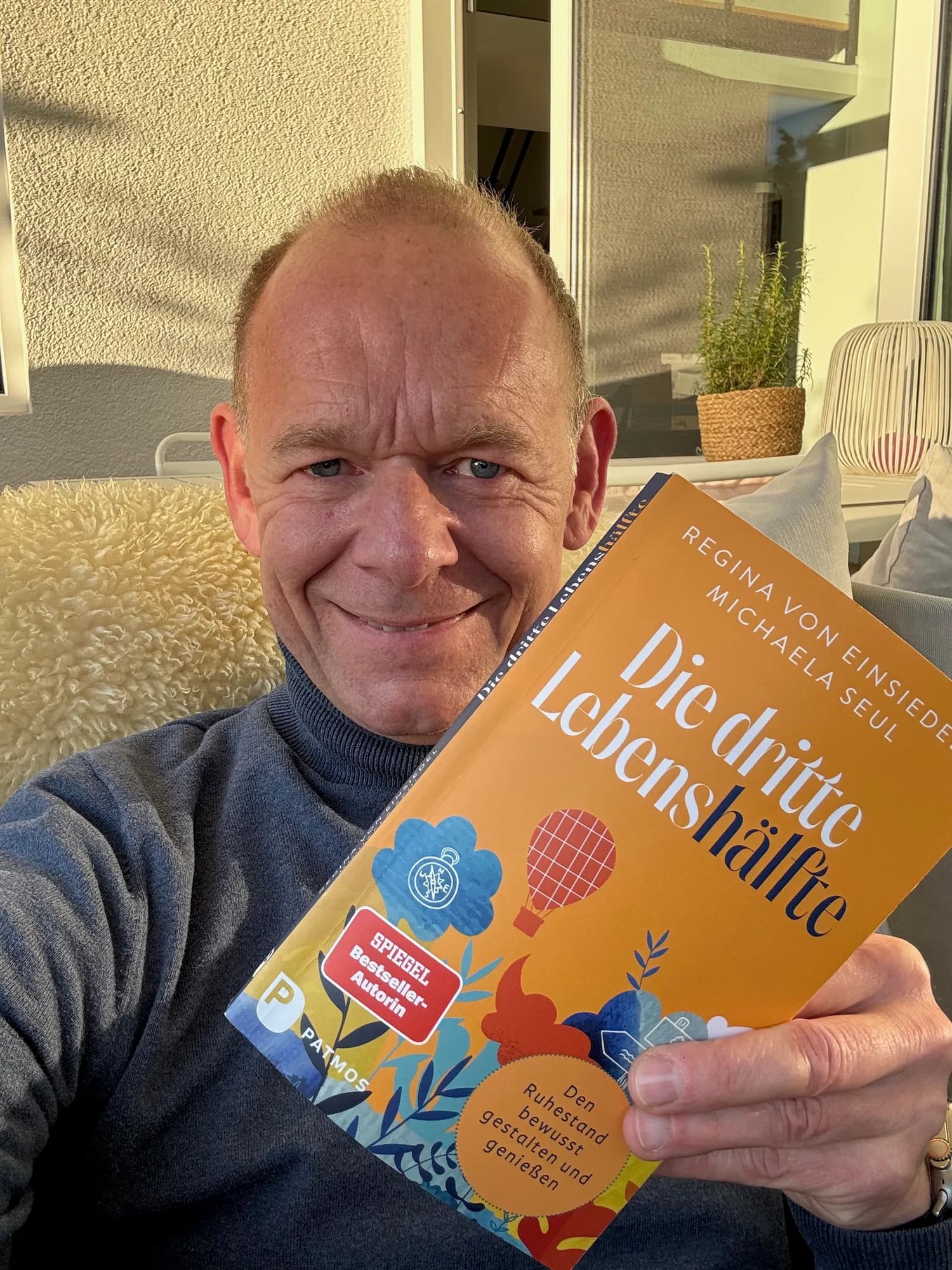
Andreas didn’t laugh. He said: ‘Precisely because you love your work so much. Because you like being recognised. Because you make a living from making a difference to people’s lives.’ He then recommended a book to me: The third half of life by Regina von Einsiedel (external link, opens in a new tab) and Michaela Seul. I read it, and he was right.
What I find in conversations
I have a great many conversations that revolve around career changes: the end of a role, an employment relationship or a career. Especially now, when there is a great deal of ‘transformation’ taking place in Germany or necessary restructuring is on the cards, these conversations are becoming increasingly common.
And time and again, I see the same pattern. People who have done a brilliant job for decades suddenly seem at a loss. They don’t know where to go next. This becomes particularly clear from the age of 55 onwards. Then it’s no longer just a question of the next job, but the much bigger one: what am I actually going to do with my life once this is over?
In these conversations, I’m sitting on the other side of the table. To be honest, though, not for much longer. At 57, it’s a question I’m asking myself too.
Empty Desk and Empty Nest
Von Einsiedel describes two patterns from her time as a senior consultant that I recognised immediately.
Empty Desk: From one day to the next, there’s no longer a desk waiting for you. No emails, no decisions to make, no one who needs anything from you. In her experience, this tends to happen more often to men who have defined themselves largely through their careers.
Empty Nest: The children have left home, and with them goes a responsibility that has shaped everyday life for years. In her observation, this tends to affect women who have done a great deal of care work.
Both feel similar: an inner emptiness where there used to be a clear purpose. And the two can coincide. Then a couple suddenly finds themselves facing an empty desk and an empty nest at the same time.
It’s not the work you miss, but what it gives you
The thought that struck me most in von Einsiedel’s work is this: most people prepare for retirement by imagining all the things they’ll no longer have to put up with. No more annoying boss, no more endless meetings, no more alarm clock. That keeps you going for a while. Von Einsiedel calls it the ‘honeymoon’. After that, the void sets in.
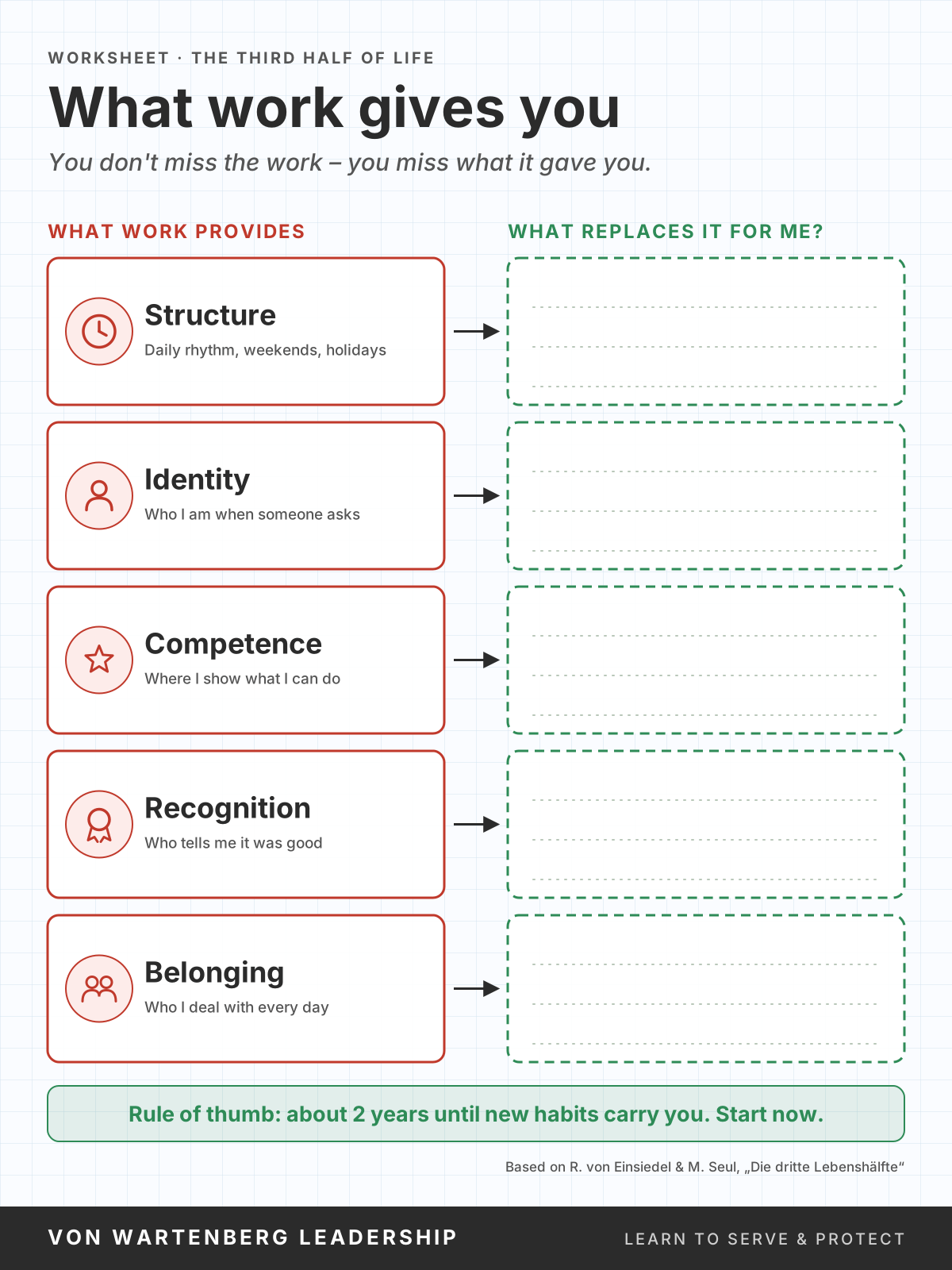
After all, work fulfils functions that we never give a second thought to as long as they are simply there:
- Structure: When I get up, when it’s the weekend, when I’m on holiday.
- Identity: Who I am, if anyone asks.
- Area of expertise: Where I can show what I’m capable of.
- Acknowledgements: Anyone who tells me it was good.
- Affiliation: The people I deal with every day.
If all of that were to disappear in a single day, Einsiedel refers to it as ‘cold turkey’. And according to the studies she has found, it hits managers particularly hard, of all people.
That got me thinking. She herself recounts how, in her early 60s, she didn’t know how she was supposed to introduce herself any more. As a former senior consultant? As a ‘retired director’? As soon as you say you’re no longer working, the conversation fizzles out.
To be honest, I know that fear. Not of having free time, but of becoming invisible.
You’re building the motorway for later, right now
Von Einsiedel uses an image that has really stuck in my mind. Our habits are like motorways in the brain: wide and well-developed, travelled on for decades, and rewarded with dopamine. When you retire, one of those motorways is closed off. You have to build the new one yourself, and that takes time. Her rule of thumb from her coaching experience: around two years – for some, less; for others, considerably more.
In other words, anyone who only starts on their last day of work is too late.
What you can do right now:
- 1Explain the functions. Which of the five roles listed above is the most important to you? What did you really enjoy about your job, and what won’t you miss for a second?
- 2Clarify your values. Are you someone who likes to help others? Who likes to make a difference? Who wants to discover new things or preserve what has stood the test of time? If you enjoy organising, you won’t find fulfilment in simply handing out food, but in running the food bank.
- 3Build to fit, not to follow trends. Von Einsiedel tells the story of a client, a sociable man who needs the limelight and feedback. For his retirement, he had planned a cellar, a motorbike and a book – all on his own. A sure-fire path to loneliness.
One listener to the programme put it succinctly: if you’ve been a homebody all your life, you won’t become a globetrotter in your retirement. You remain who you are. So plan for the person you are, not for the person you’d like to be.
My own second leg
I’ve always wanted to become self-employed. With von Wartenberg Leadership, I took my first steps, starting by building my brand. I worked on it quietly for a while, but now I’m doing it publicly. It’s a passion that comes naturally to me, gives me lots of energy and is preparing me for the second half of my life. The book was one of the reasons why I took this step at 57 rather than later.
When I look at the five functions, I can see exactly why: writing, speaking, supporting people. This gives me expertise, recognition and the opportunity to connect with others, regardless of the title on my business card.
I’m not done with it yet. For someone who loves high performance, this is perhaps the hardest lesson of all: performance remains a value. But the stage is changing, and not everything in the next chapter has to be worthwhile.
Three questions for you
- If your job were to end tomorrow, which of the five roles would you miss the most?
- How would you introduce yourself without mentioning your job?
- What are you building today that will still be standing in ten years’ time?
For further listening and reading
Although the book is aimed at people approaching retirement, I would recommend it to anyone facing a career change – and there are a great many such people at the moment. Questions about one’s role, values and identity arise whenever one steps down from a role, not just at the age of 65. It’s best to start with the podcast!
- Podcast: SWR1 Leute with Dr Regina von Einsiedel, ‘How to avoid falling into a deep hole when you retire’ (14 January 2026) [Spotify link] (external link, opens in a new tab) or [Apple Podcasts link] (external link, opens in a new tab) or [Link to the SWR podcast (external link, opens in a new tab)] (external link, opens in a new tab)
- Book: Regina von Einsiedel and Michaela Seul: The third stage of life. Planning and enjoying your retirement to the full, Patmos Verlag [Link to Amazon.de] (external link, opens in a new tab)
- GvE CoachingPlus! (external link, opens in a new tab)
How do you feel about this? I’d love to hear your thoughts at LinkedIn (external link, opens in a new tab).
Dr. Peter von Wartenberg (10.26)
Learn to Serve and Protect – Leading Myself