· 4 min read
Why do I always ask about trust in every performance review?
Clicking “Load video” establishes a connection to YouTube (in privacy-friendly mode). Data may be transmitted to the provider - see our privacy policy.
Two scales, each ranging from 1 to 5. Performance: from ‘room for improvement’ to ‘outstanding’. Trust: from ‘no trust’ to ‘blind trust’. When it comes to the question of trust, I bring two perspectives to bear – my own assessment and, if it differs, my perception of how other team members would assess this person. And vice versa.
The axis that is often missing
In most appraisal systems I have encountered in my nearly 30 years as a manager, one question dominates: How well did the employee perform? This is necessary, but not sufficient. After all, performance alone says nothing about, such as how it came about – at whose expense, in what way, and what effect it had on the team.
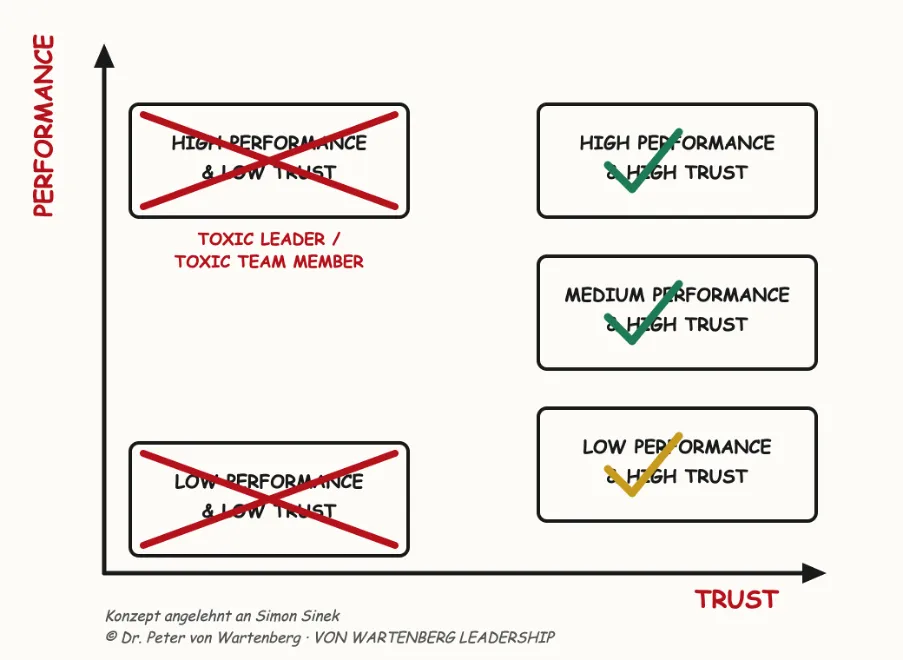
If you plot both dimensions on a matrix, the result is a framework that I have been using for years to do two things: to identify future leaders and subject matter experts at an early stage – and, just as importantly, to identify and address a very specific combination at an early stage.
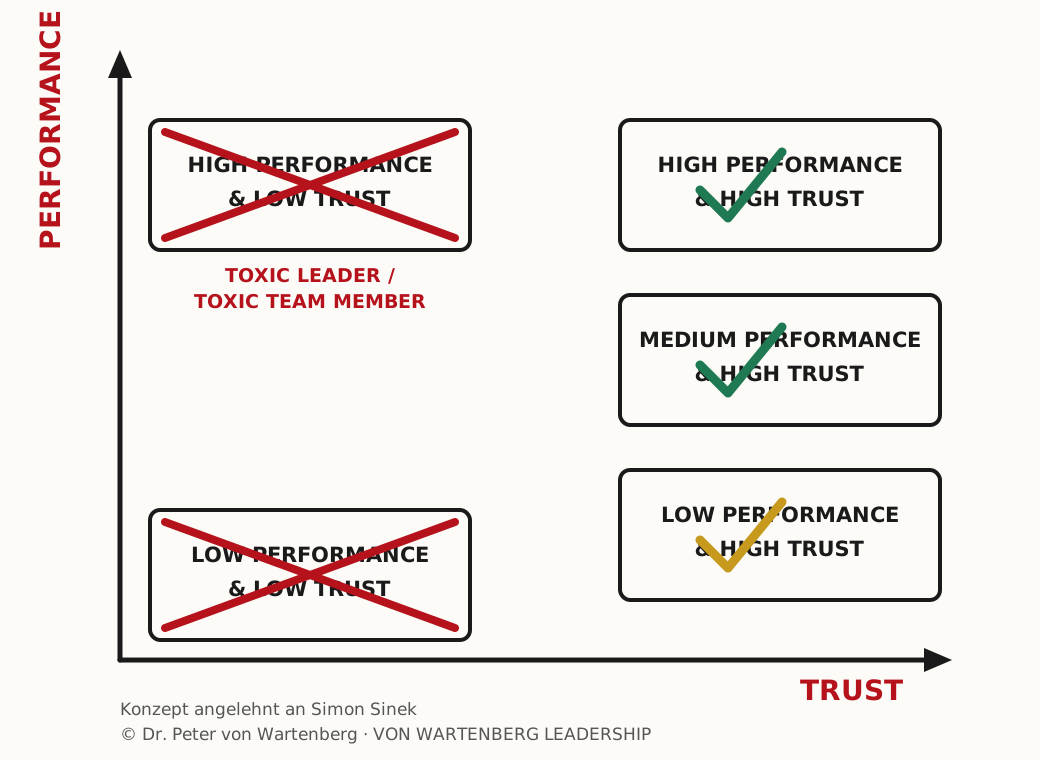
The most dangerous quadrant is not the one with low performance. It is the top-left one: high performance, low trust. The figures add up, targets are met – but the way the team is managed leaves them feeling distrustful, anxious or exhausted. In my experience, this is the most reliable indicator of a toxic leader or toxic team member. And it is the combination that goes unnoticed for the longest, precisely because the figures look so good.
On the right, in the high-trust zone, the focus shifts. Whether performance there is high, medium or low does not alter the fundamental quality of the collaboration – trust is the foundation. It is from this space that performance can be developed. This is not possible from the toxic quadrant, at least not in the long term.
An idea that I recognised later on
When I was recently writing about the A combination of psychological safety and responsibility as a form of accountability (external link, opens in a new tab) Whilst writing this – drawing on the work of Amy Edmondson and Henry Evans on accountability – I realised just how closely these two models align. Trust is, at its core, a very personal, dialogue-based version of what Edmondson calls psychological safety. Performance is the personal, conversation-based version of responsibility.
I didn’t have the right terms for it back in 2021, but I’d clearly already spotted the pattern. To be honest, that reassures me a little – it shows me that good leadership principles aren’t something we have to reinvent, but are repeatedly confirmed over the years in different languages.
Why I don't document it
One detail that is important to me: I do not record this trust assessment in writing. It is not a note in a file, but rather an opportunity for discussion. Its sole purpose is to open up an honest, constructive dialogue in both directions – not to maintain a second personnel file. That is precisely what distinguishes an assessment that instils fear from one that builds trust in the first place.
As an aside: in the very video above, which inspired me to write about this topic back then, Simon Sinek (external link, opens in a new tab) He summed up this idea very clearly in under two minutes – anyone who delivers results but trusts no one will ultimately end up leading a team made up entirely of lone wolves.
To give it a go
When you’re preparing for your next performance review, ask yourself a second question alongside the one about performance. Not ‘how good was their performance?’, but ‘how much do I trust this person – and how much does the team trust them?’ The answer to this often has a greater impact than the first.
Do you have any thoughts or comments? I’d love to hear them. Please head over to the LinkendIn Post (external link, opens in a new tab). Or drop me a message via the contact page (external link, opens in a new tab).
Dr. Peter von Wartenberg (02.21)
Part of the ‘Leading My Team’ series – on leadership, trust and the question of how high-performing teams really come about.