· 5 min read
You talk like a "watered-down fizzy drink"
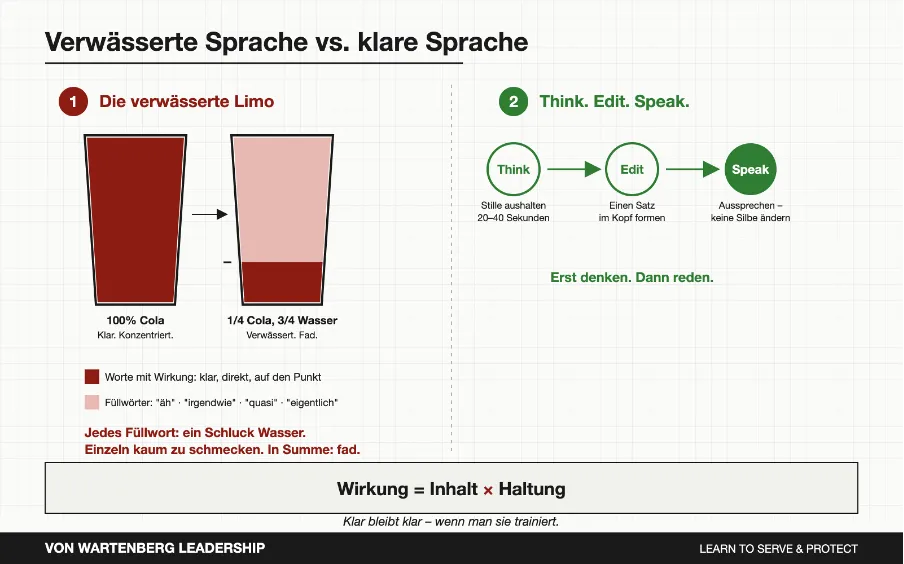
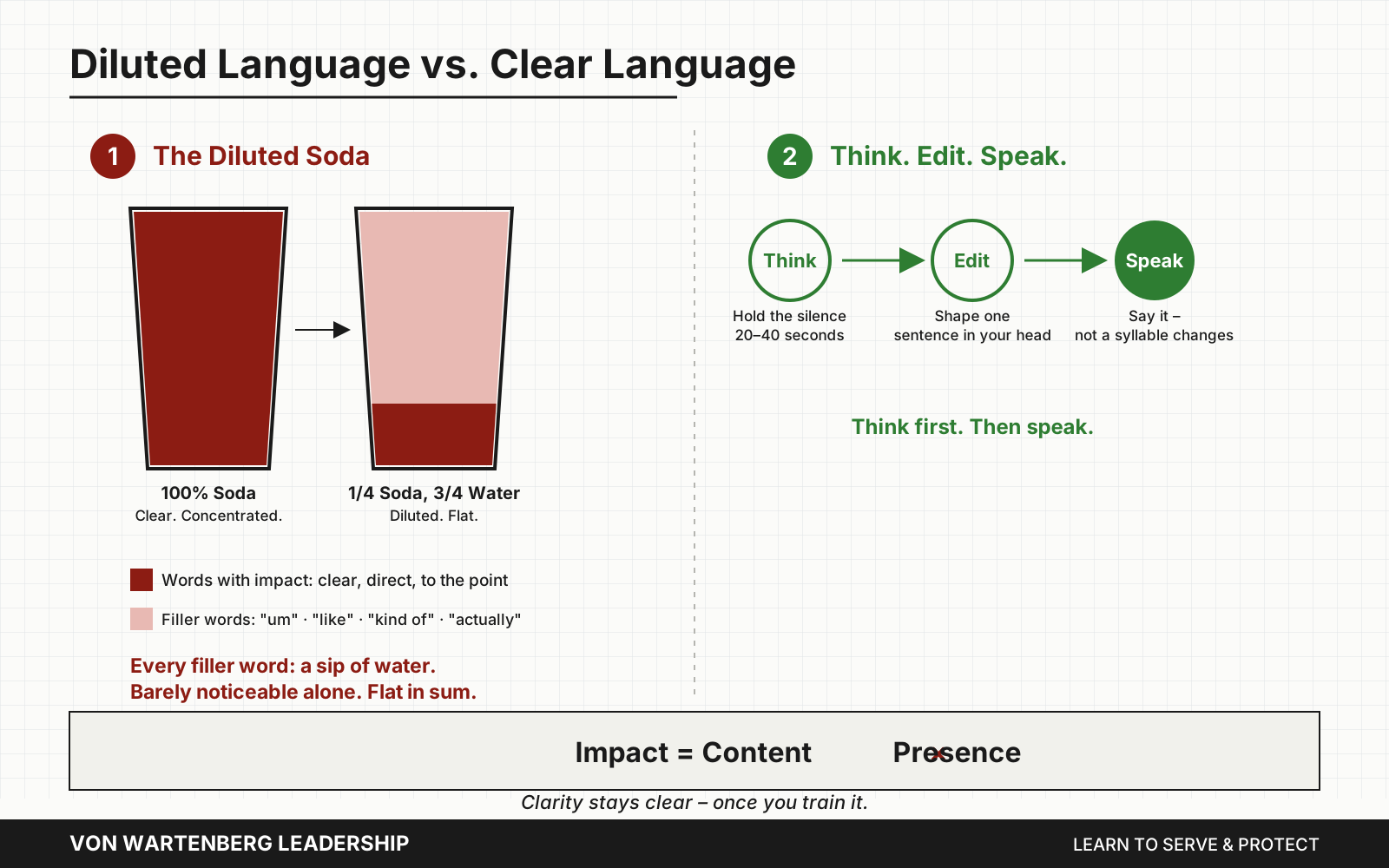
Take your favourite drink (e.g. cola). Fill a glass a quarter of the way with it, and top it up with water to make up the remaining three quarters. Give it a go.
‘Exactly,’ says Bill Hoogterp (external link, opens in a new tab) in Your Perfect Presentation… that’s how most of us sound when we speak. Not wrong. Just watered down. Every ‘er’, ‘sort of’, ‘sort of like’, ‘so to speak’ and ‘actually’ is a splash of water in a Coke. You can hardly taste it on its own. All in all: bland.
A skill that nobody is born with
I firmly believe that: A good manager must be an excellent speaker and communicator. Not because it looks good on stage, but because leadership that lacks impact fizzles out. The tricky thing is: virtually no one is born with this ability. Not even me. As a professional leader, you have to train yourself to develop it – just like any other skill for which you take responsibility.
That’s exactly where my three-day 'Own the Room' training got down to work with my entire management team in Charleston. Afterwards, I was Andreas Kleinschmidt (external link, opens in a new tab), who also worked for Own the Room as a freelancer, provided me with targeted coaching for my own presentations over the course of a few one-to-one sessions.
Think first, then speak
One exercise from the training course has stayed with me to this day: Think, Edit, Speak. The rule is simple and uncomfortable in equal measure. You don’t answer a question straight away. You endure the silence – 20, 30, sometimes 40 seconds – and during that time you formulate a single, coherent sentence in your head. Only when the sentence is finished should you say it out loud. And then you mustn’t change a single syllable.
The result: no more half-finished sentences that you have to start all over again in the middle of. No more endless loops of ‘and, er, well, what I actually wanted to say’. Instead, clarity, because the thinking had already been done before the first note was played.
What has changed within the team
What remained from those three days was less a matter of fine-tuning the rhetoric than a a fundamentally different way of talking to one another. We are treated one another with more respect. Meetings got straight to the point more quickly. Presentations became shorter and, at the same time, clearer. You could tell when someone was speaking for the audience – and not just for themselves.
Effect is not a plus, but a times
Anyone who 13 minutes wants to invest in: Bert Helbig (external link, opens in a new tab) He sums up this very principle in his TED Talk in Stuttgart – clearly, entertainingly and with an example that really sticks in the mind.
Clicking “Load video” establishes a connection to YouTube (in privacy-friendly mode). Data may be transmitted to the provider - see our privacy policy.
Impact is not simply content plus attitude towards the audience. It is content multiplied by attitude. If your attitude is zero, even the best message will come to nothing. If it’s even just a little better, it will undermine everything you say.
Why this affects all three levels
For me, that’s definitely part of Leading Myself: Before I can lead a team or a company, I need to learn to express myself clearly and effectively. And the good thing about it is that – unlike talent – it can be learnt. That’s exactly what Your Perfect Presentation For me, it’s still one of the best guides out there. As far as I know, the book is only available in English. My recommendationg: Read it first and actually do the exercises – the audiobook is then a good way to refresh your memory of the techniques later on.
Here is the Amazon link to the book Your Perfect Presentation: LINK (external link, opens in a new tab)
But it’s not just me. Charleston has shown me that the same effect applies to Leading My Team ...when a whole team trains together, rather than just the boss on their own. And I see even more in this: clear, honest and respectful communication is exactly that Foundation, on which Leading My Business (external link, opens in a new tab) grows from the bottom up. Roles and responsibilities can be defined as clearly as you like – but they only become sustainable when a team is also able to communicate with one another: to give feedback, to address conflicts, and to articulate escalations clearly rather than in a roundabout way. Communication skills are therefore not just a nice-to-have additional qualification, but one of the most important bottom-up guidelines of all.
Own the Room no longer exists under that name; the successor organisation LifeHikes (external link, opens in a new tab) It probably offers similar training courses to what it did back then. I haven’t done anything there myself yet – but it’s on my list.
When was the last time you tried your sentences – neat or watered down?
I look forward to the discussion at LinkedIn (external link, opens in a new tab).
Dr. Peter von Wartenberg (02.21)