· 8 min read
Ted Lasso – Leadership you can feel!

Ted Lasso: Why a football series about leadership had me so hooked.
Some recommendations only become clear years later. This one came from Charleston, about two years after I’d been working there for five years.
Meg Lanza (external link, opens in a new tab), a former colleague and now a friend, said to me: “Peter, you’ve got to watch Ted Lasso. He kind of reminds me of you as our plant manager.”
At first, I was taken aback. A American football coach, who suddenly had a English football club trained – what’s that got to do with me? I started watching it anyway, in English, from the first series. And to be honest, there was a lot I didn’t understand. The British and American humour, the puns and allusions – a lot of it went over my head. My verdict at the time: a bit daft, not really my thing. I’ve stopped.
This year (2026), the recommendation was made once again. There are now four series, the first series premiered on Apple TV+ in August 2020. This time, I watched it in German. And it gripped me like no other series has done for ages.
What it’s all about
Ted Lasso (external link, opens in a new tab), a football coach from Kansas, takes charge of AFC Richmond in the English Premier League. He knows next to nothing about football. It sounds like a comedy, and it is funny. But above all, it is one of the the most detailed studies on leadership, that I know. Not because of grand speeches, but because of the many small gestures. And because Ted isn’t a flawless hero, but a human being with his ups and downs – just like the characters around him.
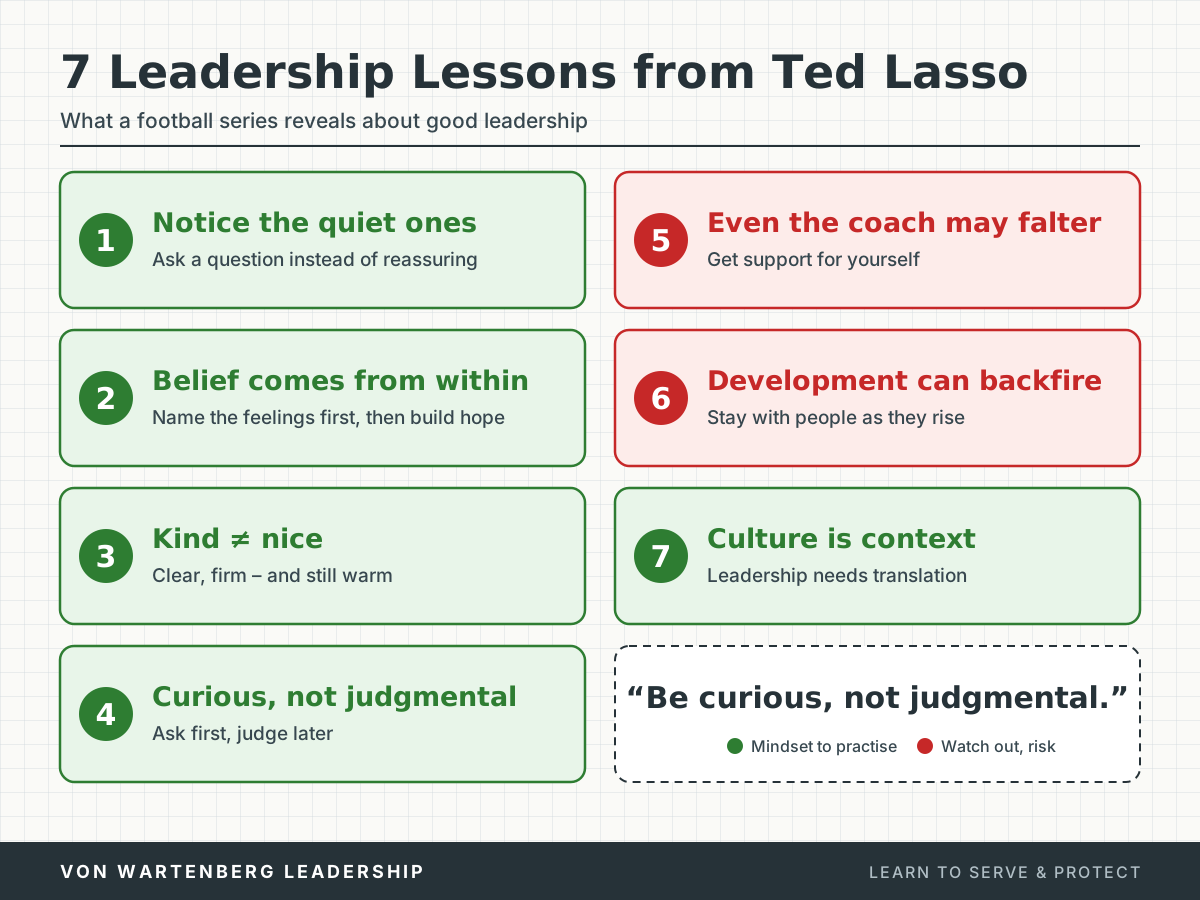
Seven things I took that home with me.
1. Look to those who are quiet
At the start, Nate is the kit man, right at the bottom of the pecking order. Yet he understands tactics better than most people at the club. When he tentatively hints at an idea, he immediately plays it down himself. Many managers would now reassure him or simply carry on. Ted asks a question: Do you think the idea will work?
In doing so, he leaves the decision in Nate’s hands. Nate has to believe in his own idea. Ted listens, gives it a chance – and when the press ask whose idea it was, he names Nate. He even gives him a nickname: “Nate the Great”. The invisible kit man becomes someone whose ideas matter.
The communication trainer Shannon Jenkins (external link, opens in a new tab) describes in her YouTube analysis: ‘Why Ted Lasso Is Such an Effective Leader’ (external link, opens in a new tab) (see also below) It’s lovely to see what many managers do instead: they say, ‘My door is always open’, ask the group for their views at the end of a meeting – and if nobody says anything, they assume there’s nothing to say. Ted carries on. He actively invites the quiet ones to join in. That is precisely what creates a sense of psychological safety. The video is well worth watching if you want to see the scenes in the original version.
2. Faith comes from within
In the third series, Richmond is in crisis. One defeat follows another, and the superstar whom everyone had relied on is bringing his career to an end. Ted does something surprising: he tears up his famous “BELIEVE”-sign, the A symbol of his entire philosophy.
The reason: The players have their faith at something outside oneself hung – on a player, on a sign. Ted brings him back inside. First, he identifies what’s really going through their minds: envy, fear, shame. And only then does he guide the team, step by step, towards hope: I am important. I can improve. We can improve.
For me, that’s a A lesson for change processes. How often does change communication begin with ‘We’re really excited about this transformation’, whilst the team is frustrated because months of work have just gone to waste? Ted meets people where they are. He doesn’t shout ‘Come over here!’ from the other side; he walks the path with them.
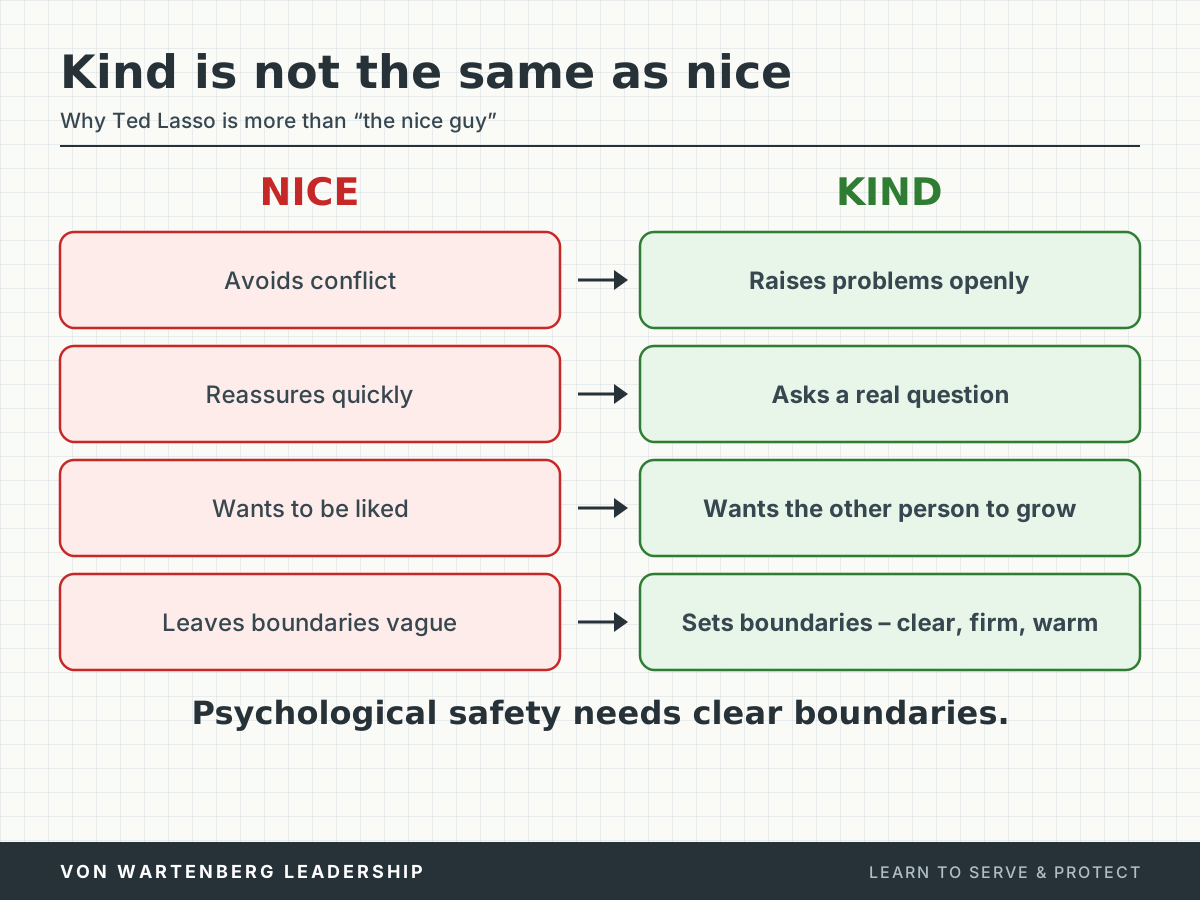
3. Being friendly is not the same as being nice
Ted is often misunderstood as ‘the nice one’. In the fourth series, it becomes clear that this isn’t enough. One of the coaches on his staff is taking her frustration out on the players more and more harshly. Ted has already spoken to her about it, but she’s ignoring him. So he suspends her for one match.
No outbursts, no humiliation, no long lectures. Clear, firm – and yet warm. This combination is much harder than simply being nice. Psychological safety does not mean that anything goes. People must have the courage to speak out, to challenge others and to make mistakes. But they must also know where the boundaries lie. It is precisely this interplay between security and responsibility that I explored in my article on “Psychological safety is the foundation. Accountability is the work" as described.

4. Be curious rather than judgemental
One of my 'Favourite Scenes' is set in a pub. Ted’s opponent challenges him to a game of darts and thinks he’s a daft lot. Ted wins – and explains in the process that people have underestimated him all his life. If they’d asked him questions instead of judging him too quickly, they’d have been wiser. His motto: “Be curious, not judgemental.”
For me, that is the essence of good leadership: Ask first, then judge. And to be honest, that phrase strikes a chord with me too. My initial reaction to the series was that it was ‘nonsensical’. I wasn’t curious enough.
5. Even the coach is allowed to falter
Ted isn't just the Optimist with the biscuit for the boss. He suffers from panic attacks, is struggling with his divorce, and finds it hard for a long time to accept help from the team psychologist. That is precisely what makes him credible.
Leadership starts with you. (external link, opens in a new tab) If you want to support others, you must also look after yourself – and it’s perfectly fine to ask for help; that’s a A sign of strength.
6. Support can also go wrong
Nate is perhaps the most honest character in the series. Ted supports him, makes him assistant manager – and Nate turns against him and switches to the rival team. Recognition alone has not stabilised his self-image. It was only much Later, he finds his way back.
This raises some genuine questions for human resources development: Do we support people even when they rise quickly through the ranks? And do we realise when encouragement turns into pressure?
7. Culture is context
I now find the fact that I didn’t understand the series in English to be almost the best punchline of all. Ted is the outsider in England himself. He understands the language, but not always the culture – and yet he remains curious. During my years in the US and Brazil, I experienced exactly that: the same message comes across very differently in a different culture. Leadership requires translation.
And Captain Picard?
The Series, the my leadership style most of all has shaped, back when I was at university Star Trek: The Next Generation (external link, opens in a new tab) with Captain Jean-Luc Picard. He relied on his knowledge and on a team he trusted. Ted Lasso is louder, more colourful and funnier. But at their core, they both share something: they listen first and have more faith in their people than they have in themselves.
Info: Unfortunately, the British actor Sir Patrick Stewart (external link, opens in a new tab) who has just passed away on 28 October 2026.
My recommendation
Have a look at Ted Lasso. And if you find British humour in English a bit tricky: watch it in German, like I do. Look at things through a manager’s eyes. As you watch the various scenes, ask yourself: How would I have reacted in this situation?
Clicking “Load video” establishes a connection to YouTube (in privacy-friendly mode). Data may be transmitted to the provider - see our privacy policy.
Here is the link to Ted Lasso on Apple TV (external link, opens in a new tab)
Pros and cons of the Ted Lasso style
Ted’s style builds trust and unlocks potential, but it requires authenticity, perseverance and clear boundaries.
Advantages
- Uncover the potential in people who would otherwise be overlooked.
- Creates a sense of psychological safety: mistakes and bad news are brought out into the open.
- Helps us weather crises, because confidence comes from within rather than from success.
- It combines warmth with consistency, and this makes it come across as credible.
Disadvantages and risks
- May be perceived as naïve or soft before the first results are in.
- It takes time; in the series, Ted loses a lot of matches for a long time.
- A heavy emotional burden for the manager themselves (see panic attacks).
- Unsupervised support can go wrong, as it did with Nate.
- It cannot be copied: anyone who imitates Ted’s folksy manner comes across as insincere. It is the mannerisms that can be emulated, not the tone.
And now I’m curious: Which moment from *Ted Lasso* has stuck in your mind? Do you have any suggestions or comments? I’d love to hear them. Please go to the LinkedIn post (external link, opens in a new tab).
I’d be delighted to discuss these topics.
Dr. Peter von Wartenberg (10.26)
VON WARTENBERG LEADERSHIP – Learn to Serve & Protect