· 9 min read
Attitude is everything: the book I didn’t just read, but devoured

There are books that you simply read. And then there are books that make you see the world in a slightly different light. “"Attitude is key" by Martin Permantier (external link, opens in a new tab) To me, it clearly falls into the second category.
I bought it a few years ago. In my management team at the time, we talked a lot about attitude: at work, in our private lives, and about how it affects others. I then actually read it properly during my summer holiday. Just under 370 pages, and to be honest, I didn’t just read it – I devoured it.
Why ‘attitude’ and not ‘behaviour’?
In organisations, we talk a lot about behaviour. What should someone do, what should they avoid, and what skills are still lacking? Permantier takes a deeper approach. His core idea: The inner attitude from which you view the world determines how you interpret it, how you act, and what reality you thereby create for yourself. Anyone who merely tweaks behaviour without recognising the underlying attitude is only scratching the surface.
In a world that we would like to VUCA (external link, opens in a new tab) ...is what matters most. If the rules are constantly changing, at some point it is no longer the rules themselves that sustain you, but what lies beneath them.
The six attitudes: a path, not a choice
At the heart of the book is a model comprising six attitudes. It is based on developmental psychology, and this is the point that is important to me: The postures build on one another. You go through 1, 2 and 3 before you even get to 4, let alone 5 and 6. You can’t skip any stage. And none of them disappear as you carry on. You take each one with you.
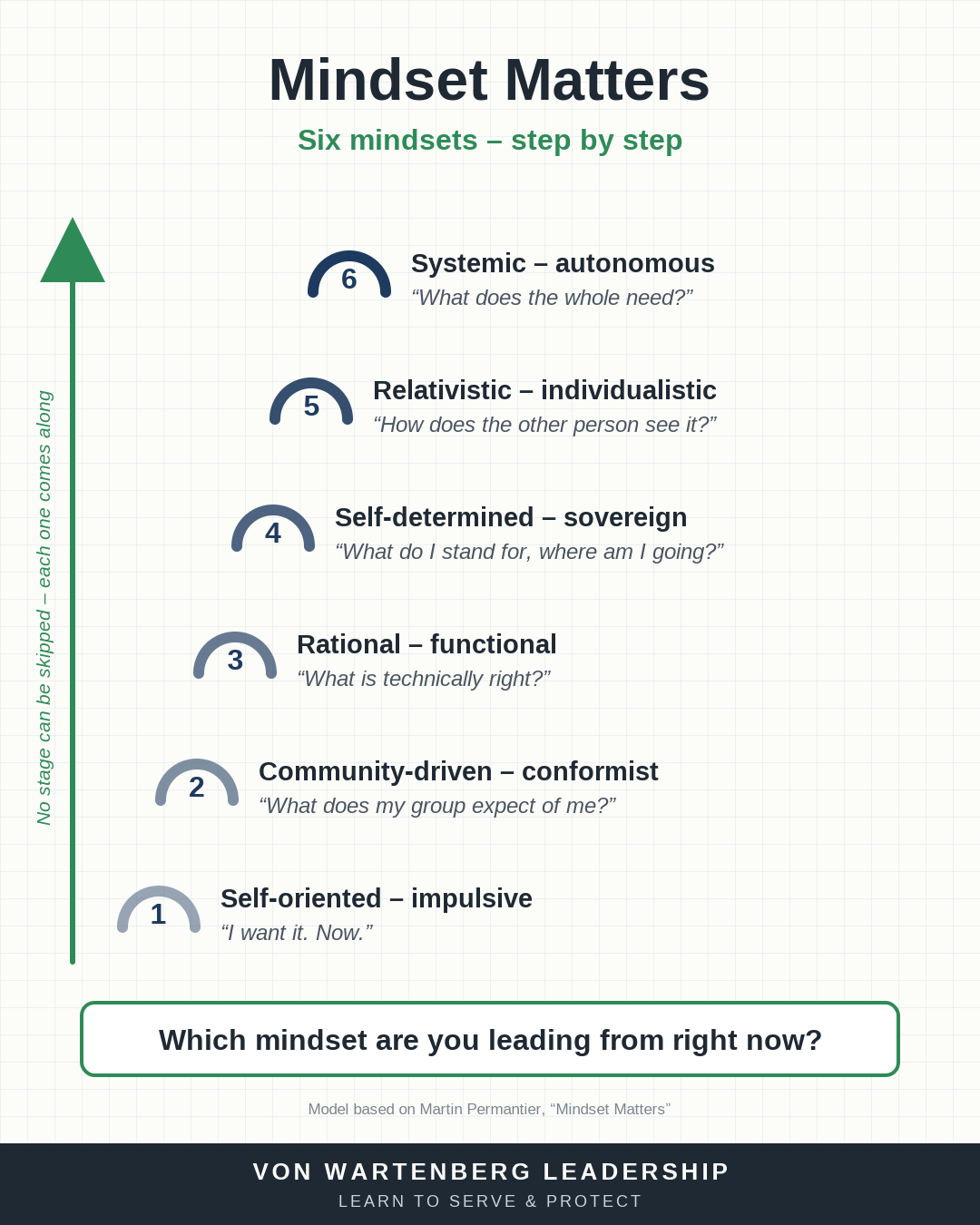
The terms are rather abstract. I’ve only managed to grasp them myself through examples. So here’s a brief scene to illustrate each attitude:
1. Self-centred and impulsive: ‘I want that. Now.’ The toddler at the supermarket checkout who wants the sweet straight away. We adults still find ourselves adopting this attitude, namely when our emotions get the better of our reason.
2. Community-oriented and conformist: ‘What does my group expect of me?’ The teenager who is desperate to wear the same trainers as everyone else in the class. At work, this comes across as: ‘That’s how we’ve always done it.’ Or: ‘The boss has to decide first.’ A sense of belonging provides security.
3. Rationalist-functional: ‘What is technically correct?’ The expert who wins people over with figures, data and facts, and who seeks out the best technical solution. Strong when it comes to quality. Challenging when others feel they aren’t being listened to because ‘the facts are clear, after all’.
4. Self-determined and self-reliant: ‘What do I stand for, and where do I want to go?’ The manager who sets their own goals, takes responsibility for results and remains true to their values even in the face of resistance. This is where genuine personal responsibility is fostered.
5. Relativist-individualist: ‘How does the other person see it, and what else is true?’ The manager who realises that their view is just one of many, and who makes a conscious effort to seek out other perspectives. The downside: if everything is relative, decisions are sometimes put off indefinitely.
6. Systemic-autonomous: ‘What does the whole require?’ Someone who recognises connections and interdependencies, can tolerate contradictions, and makes decisions not for themselves or their team, but for the system as a whole. And who, in doing so, can draw on all their previous approaches, depending on what the situation requires.
What struck me the most
Der Spiegel. I could recognise myself in all six attitudes. And to be honest: I was really proud of the moments when I realised I was thinking in a systemically-autonomous way. But just as often, I caught myself thinking differently. Rationalistic-functional, when I was only looking at the figures. Community-oriented and conformist, when I went along with the crowd instead of speaking out. And impulsive – typically whilst driving, when someone in front of me was driving too slowly. This taught me that nobody ‘is’ permanently at Level 6. The key thing is that you realise which mindset you’re acting from at any given moment.
Conflicts are being explained in a new way. Many conflicts within a team are actually no substantive conflicts. Two people look at the same problem from different perspectives, and from their point of view, they’re both right. Once you realise that, ‘he doesn’t get it’ becomes ‘he sees things differently’.
It goes far beyond leadership. This book doesn’t just make you a better leader. It also makes your personal life easier, because you’ll understand yourself and others better.
Stairs and the piano: no contradiction
In my workshops, I like to talk about the ‘piano of leadership styles’. Sometimes you lead in a transactional way, with clear instructions and clear objectives. Sometimes you lead in a transformational way, with purpose, trust and inspiration. Good leadership means playing the right key depending on the situation.
At first glance, this doesn’t seem to fit with a tiered model that clearly points upwards. I see it differently: The finger positions are the notes that you gradually learn to play. Anyone who is only familiar with Level 3 plays an octave – and perhaps does so very well. Anyone who has reached Level 5 or 6 has the whole piano at their disposal. They can consciously decide when a fact-based analysis (3) or a clear, independent statement (4) is the right approach.
So ‘higher’ doesn’t necessarily mean always playing in the upper register. ‘Higher’ means having more keys to choose from and making a conscious choice.
Strengths and limitations of the model
As much as I love this book, every model has its strengths and limitations. You should be aware of both before you start working with it.
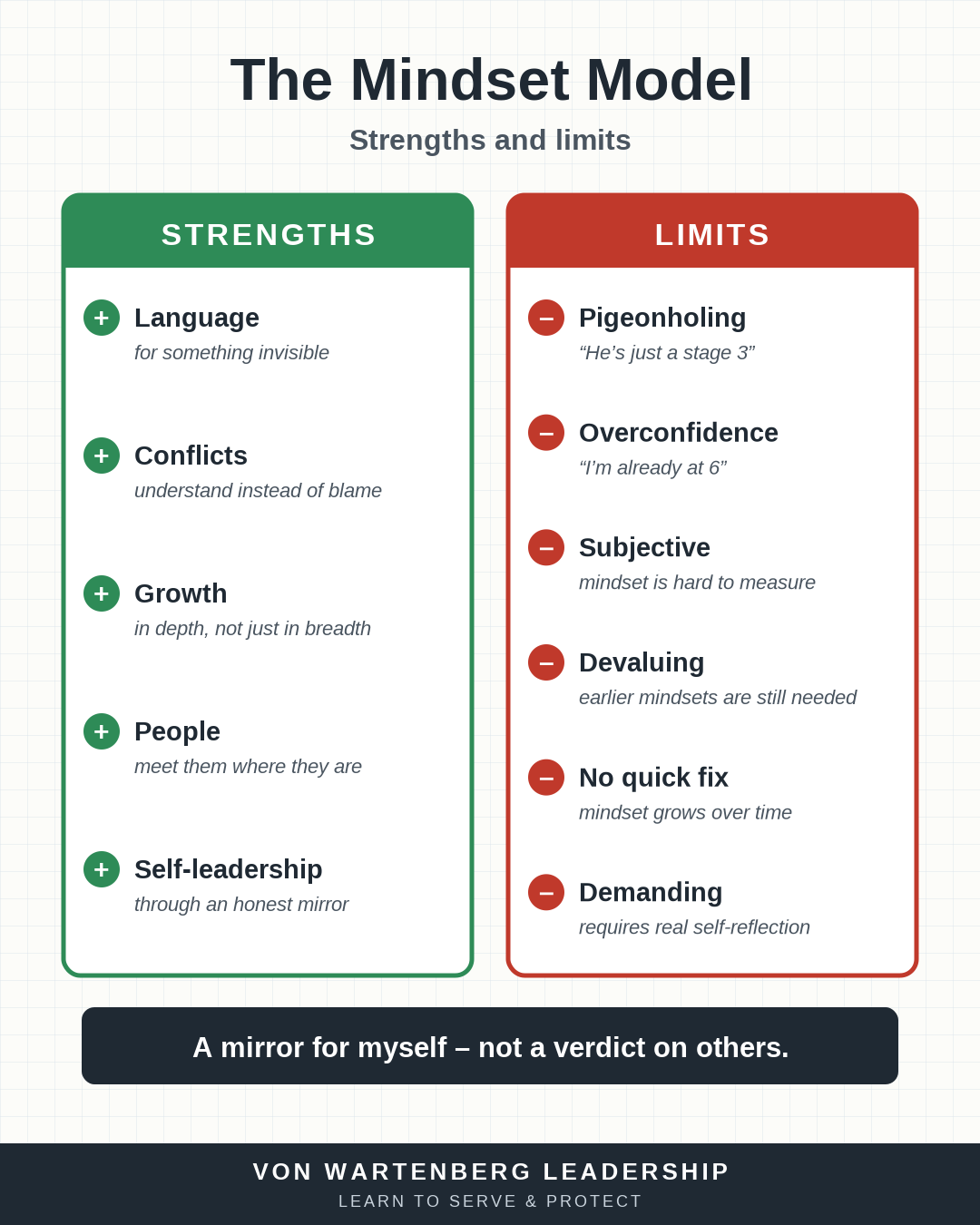
What makes this model so powerful
- It gives you a way of expressing something invisible. ‘Attitude’ is otherwise a rather vague term. With six clearly defined attitudes, you can talk about it – both to yourself and within the team.
- It explains conflicts without assigning blame. Instead of saying, ‘He doesn’t want to’, ask: ‘What’s his perspective on this?’ That takes the pressure off and opens up the conversation.
- It illustrates a path of development. Most leadership training programmes focus on new methods and tools – in other words, on broad-based development. Permantier demonstrates in-depth development: it is not about knowing more, but about seeing further.
- It helps you meet people where they are. People who follow the crowd need guidance and a sense of belonging. People who think in a rational, functional way need facts. Once you realise this, you’ll communicate more effectively.
- It enhances self-management. Above all, the model acts as a mirror. And for me, self-reflection is the starting point for all good leadership.
Where the model reaches its limits
- The danger of pigeonholing. A tiered model encourages people to categorise others: ‘He’s just on tier 3.’ This turns a tool for understanding into a tool for disparagement.
- The danger of overestimating one’s abilities. It’s just as tempting to see yourself at level 6. My mirror above shows that we fluctuate depending on the situation. Anyone who thinks they’ve ‘made it’ usually hasn’t.
- This classification is subjective. Attitude isn’t something that can be easily measured. What you see always depends on your own attitude as well.
- Previous views are easily dismissed. Conformity ensures rules and reliability, whilst the rational-functional approach ensures quality and precision. A company cannot function without these attitudes.
- Development cannot be imposed. You can’t force anyone to adopt a certain attitude, and certainly not through a seminar. Attitude develops through experience, reflection and time. Anyone looking for quick results will grow impatient with this approach.
- The book is challenging. Just under 370 pages of depth – not the sort of book you can read in passing. It demands that you really engage with it.
How I deal with it: I use this model as a mirror for myself, not as a means of judging others. That is when it reveals its true strength, and the boundaries remain manageable.
What this has to do with my understanding of leadership
In my post on psychological safety, I wrote that, for me, responsibility is not a duty but a mindset. Permantier provides the foundation for this: a mindset is not created by a declaration; it grows, step by step. That is why, for me, leadership begins with Leading Myself (external link, opens in a new tab). Before you lead others, you should be aware of the mindset from which you are doing so.
And what about the next book?
In 2023, Permantier followed this up with *Expanding Your Perspective*. It focuses on the self, the team, the organisation and the bigger picture, featuring plenty of new diagrams and more practical examples. To be honest, I started reading it but didn’t finish it, as a lot of it felt repetitive to me. If you want to delve deeper, it’s definitely worth a read. However, I’d always start with *‘Attitude Matters’*.
My tip: read first, then watch
I usually recommend watching the video first, then reading the book. In this case, I’d do it the other way round. Read the book first and look after that Martin Permantier’s videos on haltung-entscheidet.de (external link, opens in a new tab) and on YouTube. With the background information from the book, a lot of things become easier to understand, and the new knowledge sticks better. There is also an English edition, entitled “Mindset Matters”.
Outlook
A good match for this topic is a Podcast: Martin Permantier in conversation with Jens Corssen about Self-development as a ‘choice to grow through life’ (external link, opens in a new tab)”. A quiet conversation, perfect for a car journey of about an hour. And perhaps the answer to the question that remains unanswered after this post: How do you actually move from one mindset to the next?
My conclusion
If you want to become even better – as a manager, as a team member, within your family, as a person – then read this book. If you’re happy to stay where you are today, you don’t need it. Enjoy the journey!
Amazon link to the book "Attitude is key (external link, opens in a new tab)" & Amazon link to the book "Expand your posture (external link, opens in a new tab)"
If you have any suggestions, comments or questions – or if you simply like it – I’d be delighted if you popped over to the LinkedIn post (external link, opens in a new tab).
Dr. Peter von Wartenberg (10.21 & 11.26)
Learn to Serve and Protect