· 7 min read
The end of win-win? Why I’m still banking on the infinite game!
Conflicts, yes; but let’s avoid negotiations
I’ve always been someone who faces up to conflict. Conflicts are there to be tackled, not avoided. It was different when it came to negotiating. I did it because it was part of my responsibilities: out of a sense of duty, not because I enjoyed it. I lacked a strategy I could rely on. That Harvard approach (external link, opens in a new tab) Although I was familiar with the concept of ‘win-win’ from my university days, it hadn’t really taken root in my mind.
Then came 2020. Covid-19. From one day to the next, people had to stay at home; some had barely any real work left. I had to negotiate with the works councils on how to manage working hours and support our staff. In the past, consultants had supported me during major negotiations. Now I was on my own, and I had to step up straight away.
What the Schranner concept has given me
I came across The Schranner Concept (external link, opens in a new tab) by Matthias Schranner (external link, opens in a new tab) came across. Schranner used to negotiate with hostage-takers whilst working for the police and now advises governments, corporations and international organisations.
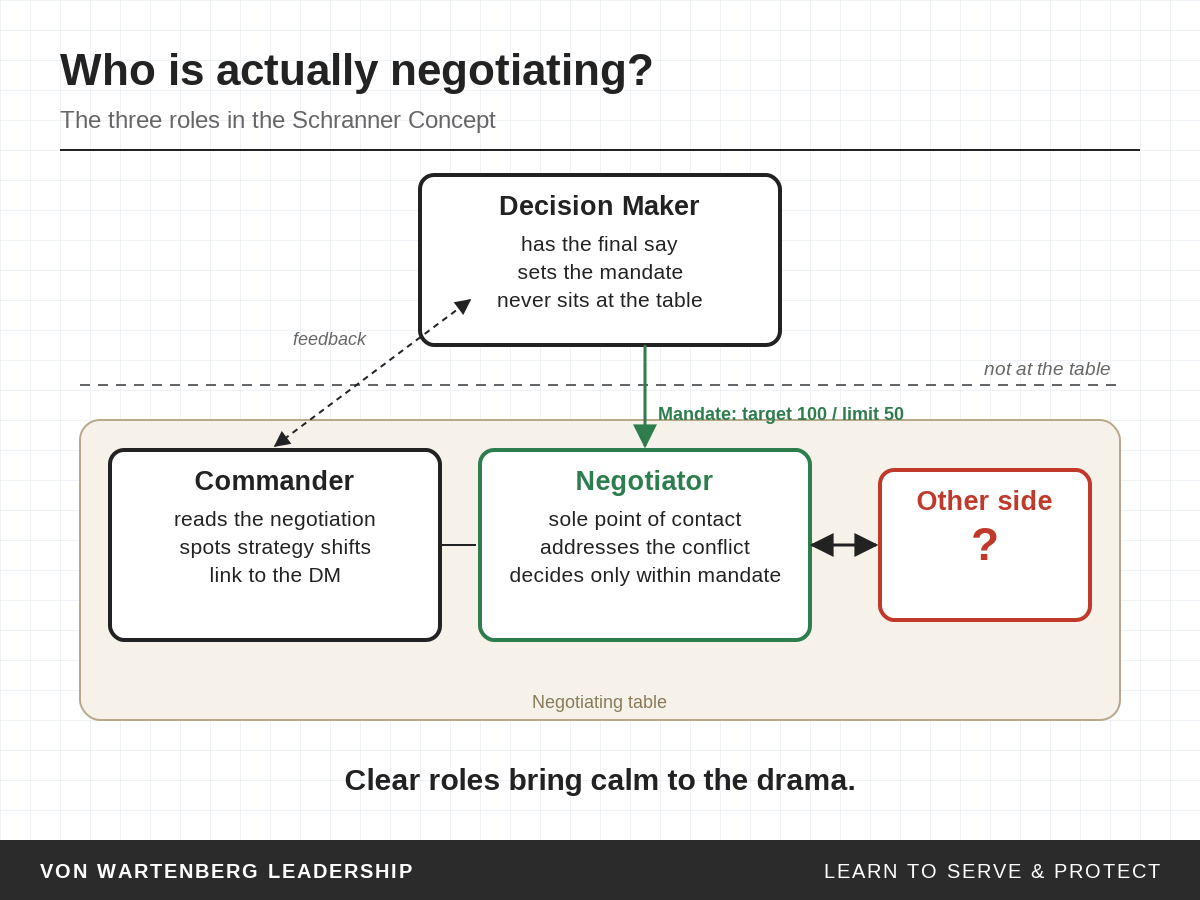
It wasn’t the harshness that convinced me, but the structure. Schranner draws a clear distinction between the roles:
- Decision-maker: He makes the final decision and sets out a clear mandate for the team. However, he never sits at the table himself. This ensures that his reputation remains unblemished during the negotiations.
- Chief negotiator: is the sole point of contact for the other party and raises the issue of the dispute during the negotiations. He may only make decisions within the scope of his mandate.
- Commander: He sits on the sidelines and observes the negotiations. He notices when the other side changes its strategy, whilst the lead negotiator, under pressure, develops tunnel vision. And he maintains the link with the decision-maker.
Suddenly, I knew who was negotiating, what my role was, and what I, as the decision-maker, should not do at that moment. We underwent training as a team, and all of a sudden I found myself enjoying the negotiation process.
My Objection: The Infinite Game
Even so, I didn’t quite feel ‘at home’ with Schranner. His approach is geared towards winning. I, however, firmly believe in the Infinite Game: in many relationships, there is no endgame.
This is particularly true when you’re dealing with a works council. Today I’m negotiating working hours, tomorrow something else – with the same people. If I win today, someone else loses. And that someone will be sitting opposite me again tomorrow. I want to win, yes. But in such a way that I still have a chance to win something again tomorrow.
Six years later: The end of Win-Win
Schranner has now written a new book: The End of Win-Win: Negotiating in an Age of Intransigence. His argument is that a win-win approach fails when dealing with negotiators who respond to every concession by making a higher demand. Moral appeals then fall on deaf ears.
I came across it whilst watching his appearance on the Podcast Hotel Matze (external link, opens in a new tab). Two and a half hours well spent. Here’s what I took away from it:
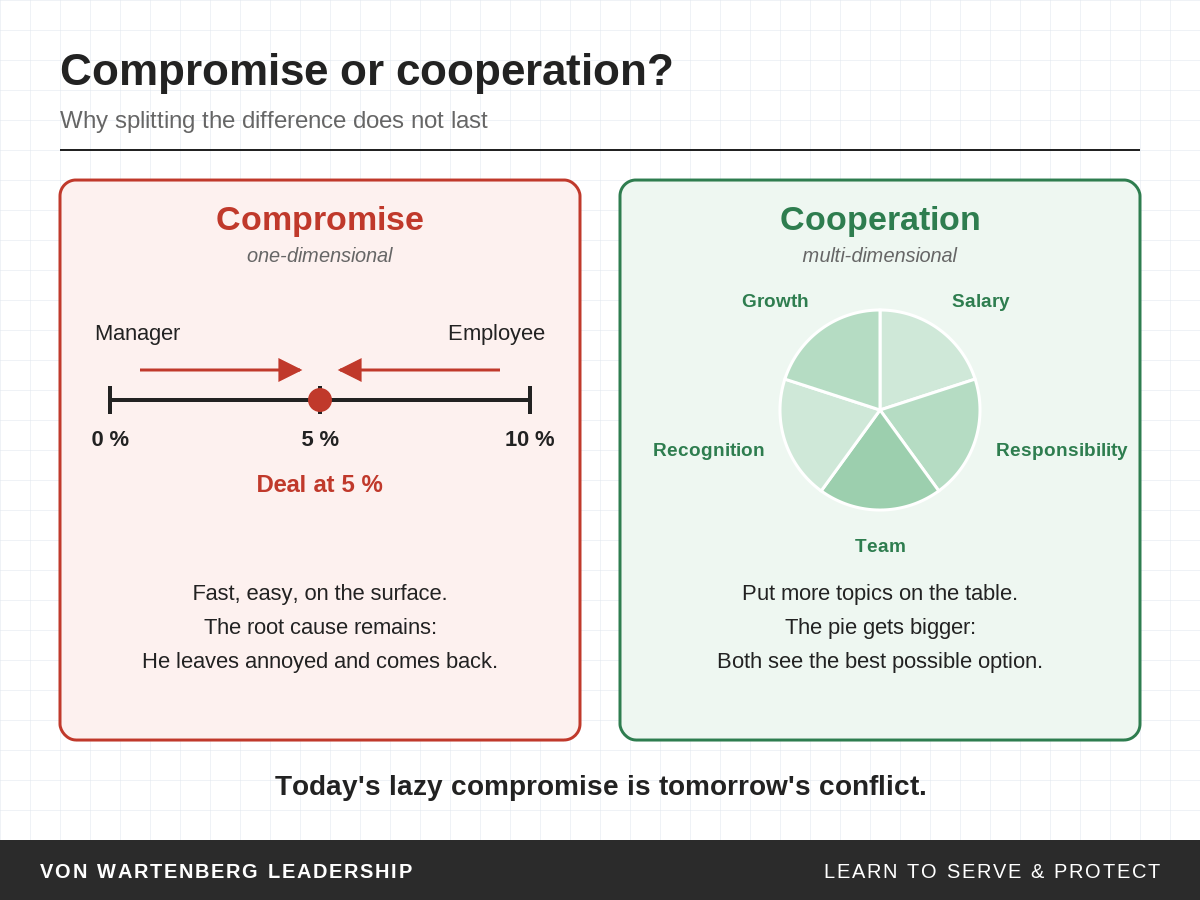
- A compromise is not a negotiation. The employee wants a 10 per cent pay rise, the boss wants 0 per cent; they quickly agree on 5 per cent. Nobody asks what lies behind the 10 per cent – for example, a lack of recognition. He walks out angry anyway and is back out on the street in six months’ time. Cooperation is better: bring more issues to the table so that the pie gets bigger.
- Don’t negotiate with yourself. We lose most negotiations before they even begin: in our own minds. We agonise over what the other side might be thinking, run through possible objections, and start making concessions in our minds. By the end, we’re exhausted, our room for manoeuvre has shrunk, and we believe the others see it the same way. Schranner’s advice: work out what you want yourself, and then go in. You’ll find out what the other side is thinking once you’re at the table. That’s exactly what I used to do: negotiate with myself before I’d even sat down at the table. No wonder negotiating wasn’t much fun back then.
- Anyone who is determined to be right stops negotiating. From their point of view, the other person is also in the right. As soon as words like ‘right’, ‘wrong’, ‘fair’ or ‘unfair’ are mentioned, the focus shifts from finding a solution to proving who is right. At that point, neither side can make any concessions without losing face. The better question, therefore, is not ‘Who is right?’, but ‘What do we both need to move forward?’
- Separate the past from the future. “But last year you …” leads to feelings of guilt and strong emotions. The past is dealt with elsewhere; at the table, we discuss the future.
- Let the other side find the solution. Endure the silence. Don’t say ‘I understand you’ and don’t make yourself seem more important. Talk about ‘the two of us’.
- Negotiation is about managing frustration. It rarely works the first time round. The trick is to keep at it, look for a new approach and try again.
And a quote I’d hang above my desk: "Face up to the conflict, otherwise it will resurface at the worst possible moment."
“So when will it ever end?” – “Never.”
The bit that made me laugh: According to Schranner, it’s only us Germans who think a handshake marks the end of the matter. Elsewhere, an hour later, someone rings up and says, ‘I’ve got another idea.’ The professional replies, ‘Good thing you rang – I’ve got two more as well.’ When asked when it would all be over, Schranner says: “Never.”
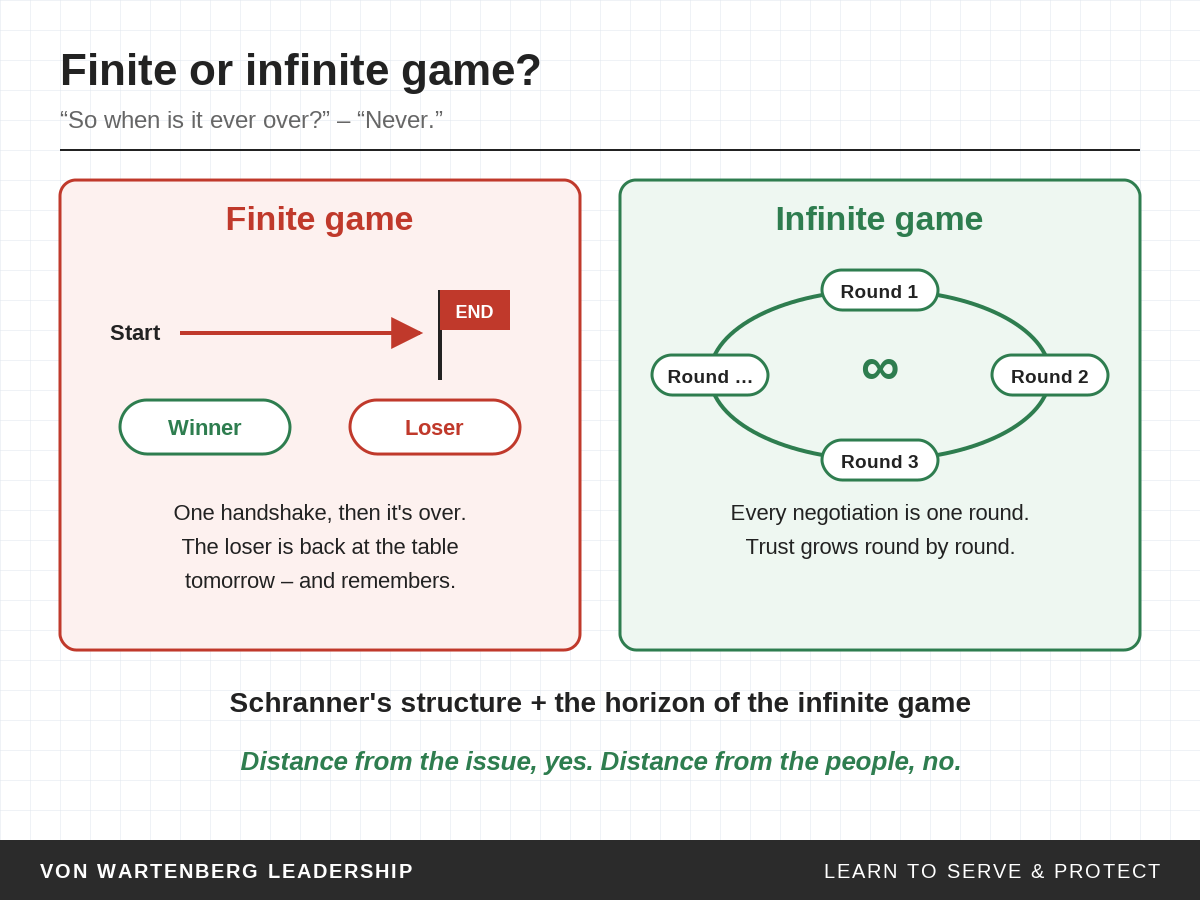
The man who proclaims the end of ‘win-win’ is, in doing so, describing the infinite game quite accurately. To me, that means:
- Negotiate with Schranner’s structure: clear roles, a positive goal, a mandate and the ability to cope with conflict.
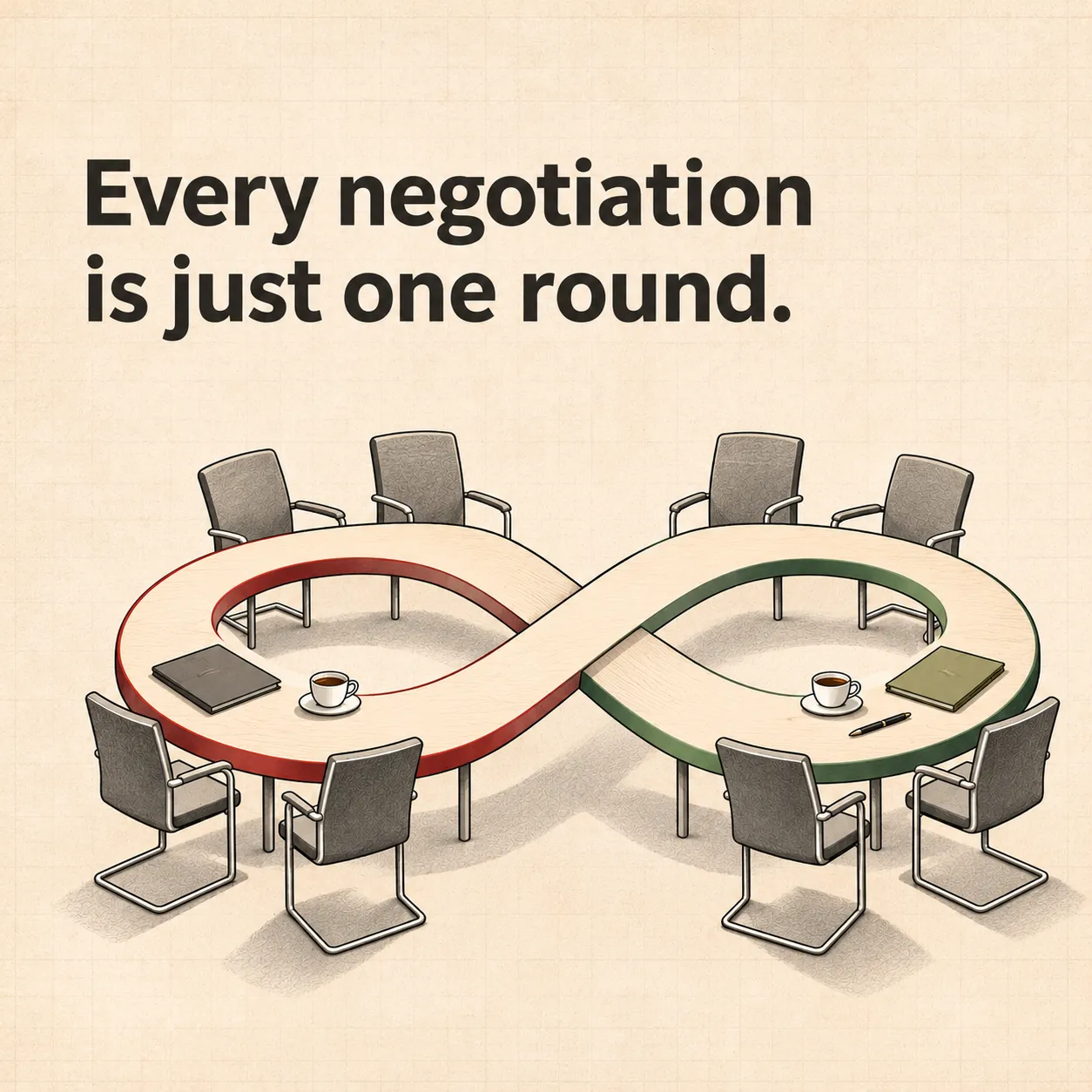
- And with the horizon of the infinite game: Every negotiation is just one round, not the final one. Today’s half-hearted compromise is tomorrow’s conflict. And anyone who leaves a scorched-earth policy in their wake today will have no one left to call tomorrow.
Schranner says of himself that he always negotiates from a distance. As an external adviser, he can do that. A leader will be sitting opposite those people again tomorrow.
But be careful: A relationship is also a point of weakness. Schranner puts it plainly: if you want to preserve harmony, you give in. And if you want to be liked, you become vulnerable to blackmail. If you think of the relationship every time a demand is made, you end up making concessions to keep the peace, and the other side quickly realises this.
The solution lies in Schranner’s framework itself. The decision-maker nurtures the relationship and discusses the shared goal and the future. The negotiator remains firm on the issues. In this way, the relationship does not become a bargaining chip. My conclusion is therefore this: keep your distance from the issue, yes; keep your distance from the people, no. But the relationship is the horizon, not the price.
For me, ‘win-win’ is no longer just a method, but a mindset. It ties in with what I stand for when I say ‘Learn to serve & protect’: protecting also means safeguarding the relationship in which negotiations will continue tomorrow. But certainly not by buying that protection through compromise.
My recommendations
- 1The podcast: Hotel Matze with Matthias Schranner, ‘What is the art of negotiation?’ (23 September 2026). LINK to the episode (external link, opens in a new tab) or Spotify (external link, opens in a new tab) (and at the bottom of YouTube (external link, opens in a new tab))
- 2The new book: The End of Win-win (Econ), also available as an audiobook. Towards the end, the peace negotiations drag on a bit, but the rest is well worth reading. LINK (external link, opens in a new tab)
- 3The basis: The Schranner Concept (Econ). If you want to learn how to negotiate systematically, this is the place to start. LINK (external link, opens in a new tab)
Clicking “Load video” establishes a connection to YouTube (in privacy-friendly mode). Data may be transmitted to the provider - see our privacy policy.
At Notes, Questions and Comments I like going to that LinkedIn post (external link, opens in a new tab).
Dr. Peter von Wartenberg (11.26)
Learn to Serve and Protect